
MapPlot and MapTransformation (mp) Resources
- mpAreaGroupCount (MapPlot)
-
mpAreaGroupCount specifies the total number of area groups,
including the "default" group, the three fixed (or geophysical)
groups, and the dynamic (or political) groups (a minimum of six). The
minimum, as well as the default, value of mpAreaGroupCount is
10. The maximum value is 255. Attempts to set
mpAreaGroupCount to values outside this range result in a
warning and a restoration of the default value.
When using the
RANGSdatabase this resource is ignored. - mpAreaMaskingOn (MapPlot)
-
This boolean resource is the master switch for enabling the area
masking facility. If True, MapPlot enables area
masking, causing areas named in the mpMaskAreaSpecifiers array
to remain unfilled, consequently allowing previously drawn plot elements
to be visible within the areas' outlines. If False, no masking is performed,
regardless of the contents of mpMaskAreaSpecifiers. For convenience,
setting mpMaskAreaSpecifiers causes mpAreaMaskingOn to
be set True, if it is not explicitly set otherwise in the same call.
When using the
RANGSdatabase this resource is ignored. - mpAreaNames (MapPlot)
-
mpAreaNames is a string array resource you can use to
retrieve the names of all areas in a MapPlot
database. You need to know these names, including specific
details of their spelling, in order to use the specifier resources
(mpFillAreaSpecifiers, mpOutlineSpecifiers, or
mpMaskAreaSpecifiers). There is a unique name for each
distinct area. However, the form of the names differs depending on the
database in use.
You can also set this resource to rename the area names, perhaps to better represent the conventions of another locale. You must set the complete list of names at the same time. Keep in mind that the order of areas is fixed: a particular element of the array always refers to the same area in the database you are using regardless of the name you give it.
- When using the
Ncarg4_0database: - All names that are compounds of several words use the hyphen character ('-') to separate the individual words. In several cases where the names would otherwise not be unique, an underscore character ('_') followed by a digit is appended to the end of the name. If you use a SetValues call to rename the areas, it is your responsibility to ensure that you do not duplicate the names of any areas. Only one of a group of identically named areas will remain accessible. See the Ncarg4_0 database table for the list of area names.
- When using the
Ncarg4_1database: - Each geographic entity in the
Ncarg4_1database is defined in a hierarchical manner as a descendent of one of the two top level elements "Land" and "Water". Therefore each entity has a "fully-qualified" name that starts with the term "Land" or "Water". Colons separate entities that have different levels (see mpAreaTypes) and periods separate child entities that are conceptually at the same level. For example, the island of Tasmania has the fully qualified name "Land : Australia : Australia . Tasmania", where the first "Australia" is the continent and the second is the country of which Tasmania is a part. However, mpAreaNames does not return the fully-qualified name of the resource. Instead it returns only enough of the name, starting from the right, to ensure that it is unique. In this case it would be simply the string "Tasmania". If another entity named "Tasmania" existed in the dataset, it would return "Australia . Tasmania".The
Ncarg4_1version of the database provides several different datasets, that while similar in their overall content, provide different types and levels of geographic detail. See mpDataSetName for a list of the datasets available with this database, along with links to tables of detailing their contents. - When using the
RANGSdatabase: - This resource is not used and is set to
NULL.
- When using the
- mpAreaTypes (MapPlot)
-
This read-only integer array resource contains the integer value of the
type of each area in a MapPlot database. Each
element gives the type of the area named by the corresponding element
of the mpAreaNames array. The meaning and value of these types
vary depending on the value of mpDataBaseVersion.
- When using the
Ncarg4_0database: - Areas are classified into eight types. These types are as follows:
- (0) mpOcean
- (1) mpContinent
- (2) mpLargeIsland
- (3) mpSmallIsland
- (4) mpInlandWater
- (5) mpNational
- (6) mpUSStateLand
- (7) mpUSStateWater
- When using the
Ncarg4_1database: - Areas are classified into four or five
four types. These types represent the four or five levels of
the hierarchical classification scheme currently represented in the
database. More types may be added if and when areas at other levels of the
hierarchy are added to the database. The current types are as follows:
- (1) land or water
- (2) continental boundary
- (3) national boundary
- (4) state or provincial boundary
- (5) county boundary or climate division
- When using the
RANGSdatabase: - This resource is not used and is set to
NULL.
- When using the
- mpBottomAngleF (MapTransformation)
-
When mpLimitMode has the value
Angles, this resource specifies the positive angle in degrees down from the center to the edge of the projection, or, if using a satellite projection, the displacement angle down from the satellite line of sight to the projection center. Note that direction of the line over which the angle is measured remains parallel to the left edge of the viewport, regardless of the rotation angle applied to the projection. mpBottomAngleF has a maximum allowable value that varies depending on the projection. - mpBottomMapPosF (MapTransformation)
- This read-only resource contains the coordinate of the bottom edge of the projected area in NDC space.
- mpBottomNDCF (MapTransformation)
-
When mpLimitMode has the value
NDC, this resource specifies the bottom edge of the limiting rectangle in Normalized Device Coordinates. If mpBottomNDCF is set to a value greater than mpRightNDCF, a warning is issued and the values are exchanged. Since the relationship between the map projection area and NDC coordinates changes whenever the map limits are changed, as well as when the viewport area is moved or resized, MapTransformation resets the value of mpBottomNDCF to the NDC value of the bottom edge of the projected area at the end of any update to the transformation. - mpBottomNPCF (MapTransformation)
-
When mpLimitMode has the value
NPC, this resource specifies the bottom edge of the limiting rectangle in Normalized Projection Coordinates. mpBottomNPCF is constrained to values in the range 0.0 through 1.0. If mpBottomNPCF is set to a value greater than mpTopNPCF, a warning is issued and the values are exchanged. The value of mpBottomNPCF is updated whenever the map limits are set using any of the map limit modes. - mpBottomPointLatF (MapTransformation)
-
When mpLimitMode has the value
Points, this resource specifies the latitude, in degrees, of a point along the bottom edge of the limiting rectangle. - mpBottomPointLonF (MapTransformation)
-
When mpLimitMode has the value
Points, this resource specifies the longitude, in degrees, of a point along the bottom edge of the limiting rectangle. - mpBottomWindowF (MapTransformation)
-
When mpLimitMode has the value
Window, this resource specifies the value, in window coordinates, of the bottom edge of the projection. - mpCenterLatF (MapTransformation)
-
This resource defines the latitude of the center of the map projection
coordinate system. It applies for all values of the
mpProjection resource except for
LambertConformal. Its value must lie between -90.0 and +90.0, where -90.0 represents the South Pole and +90.0 represents the North Pole. - mpCenterLonF (MapTransformation)
-
This resource defines the longitude of the center of the map
projection coordinate system. It applies for all values of the
mpProjection resource except for
LambertConformal. Its value must lie between -180.0 and +180.0, where both extremes represent the longitude of the International Dateline. - mpCenterRotF (MapTransformation)
-
Unless the origin lies at one of the poles, this resource defines the
angle that the map projection coordinate system is rotated
counterclockwise from a vector directed north with origin at the
projection center. If the projection center is at the North Pole, the
vector points in the direction of mpCenterLonF+180.0. If
the center is the South Pole, the vector points in the direction of
mpCenterLonF. mpCenterRotF applies for all values of
the mpProjection resource except for
LambertConformal. - mpCountyLineColor (MapPlot)
-
Available in version 6.1.0 and later.
This resource of type NhlTColorIndex can be set using a named color string or an integer value. It specifies the color used to render interior county or climate division boundary outlines. Currently these are available within the Conterminous United States only. It has no effect on County or climate division boundary lines that are coincident with state or geographical boundaries.
This resource is ignored unless mpDataBaseVersion is set to
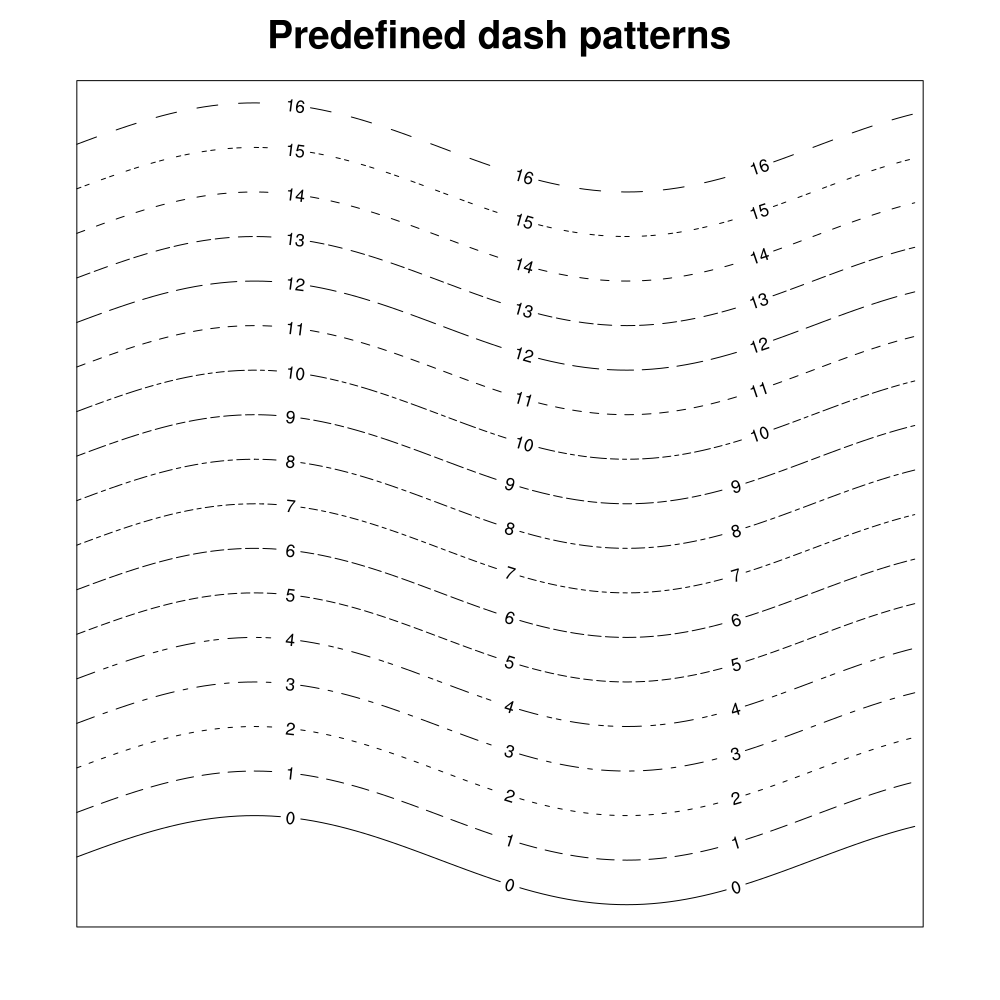
Ncarg4_1(MediumRes). - mpCountyLineDashPattern (MapPlot)
-
Available in version 6.1.0 and later.
This resource sets the index specifying the dash pattern used to render interior county or climate division boundary outlines. Currently these are available within the Conterminous United States only. It has no effect on County or climate division boundary lines that are coincident with state or geographical boundaries.
This resource is ignored unless mpDataBaseVersion is set to
Ncarg4_1(MediumRes). p> Default:SolidLine - mpCountyLineDashSegLenF (MapPlot)
-
Available in version 6.1.0 and later.
This resource specifies the length of each segment of the dash patterns used to render interior county or climate division boundary outlines. It is the length in NDC before the dash pattern repeats itself. This resource automatically scales with changes in the size of the viewport of the MapPlot object. These boundaries are currently available within the Conterminous United States only. This resource has no effect on County or climate division boundary lines that are coincident with state or geographical boundaries. MapPlot sets the default value of mpCountyLineDashSegLenF dynamically based on the ratio of the actual plot viewport width to a reference viewport width of 0.6 and a reference dash segment length of 0.15.
This resource is ignored unless mpDataBaseVersion is set to
Ncarg4_1(MediumRes). - mpCountyLineThicknessF (MapPlot)
-
Available in version 6.1.0 and later.
This resource Sets the thickness of the lines used to render interior county or climate division boundary outlines. The value acts as a multiplier of a (device-dependent) unit thickness. Currently these boundaries areavailable within the Conterminous United States only. This resource has no effect on County or climate division boundary lines that are coincident with state or geographical boundaries.
This resource is ignored unless mpDataBaseVersion is set to
Ncarg4_1(MediumRes). - mpDataBaseVersion (MapPlot)
-
This resource of type
NhlTMapDataBaseVersion
determines which database version MapPlot should use.
Currently there are four choices:
Ncarg4_0(alias:LowRes)- Use the original
database as supplied with MapPlot in
version 4.0. This database is out of date with respect to political
boundaries and has much lower resolution than the
Ncarg4_1database. Nevertheless, for global scale plots that involve only geophysical boundaries, this database is the recommended one to use. Because there are so many fewer points, MapPlot can render the data much faster, particularly when fill is involved. This database contains 583 named geographical entities. Ncarg4_1(alias:MediumRes)- Use one of the map datasets developed for the
Ncarg4_1version of the MapPlot database. These datasets contain between 1085 and 6853 geographical entities arranged in an extensible hierarchical fashion. The database is organized in such a way that new subdivisions of existing areas can easily be added. The resolution is much higher than the original database, and the political boundaries are more up-to-date. Use of this database is recommended when plotting limited areas of the earth's surface, any time up-to-date political boundaries are required, or when certain subdivisions of the United States, Canada, or Mexico are desired. Select the dataset using the resource mpDataSetName. The datasets available are:- Earth..1 (includes national and US state boundaries)
- Earth..2 (includes, national, Canadian provincial, US and Mexican state, and US county boundaries)
- Earth..3 (includes, national, Canadian provincial, US and Mexican state, and US climate division boundaries)
- (Available in version 5.1.0 and later.) Earth..4 (includes US, Canadian, Mexican, Chinese, Indian, Brazilian, and Australian state/provincial boundaries and US county boundaries.)
RANGS_GSHHS(aliases:HighRes,RANGS)- Use the multi-resolution coastline database RANGS (Regionally
Accessible Nested Global Shorelines), developed by Rainer Feistel from
Wessel and Smith's GSHHS (Global Self-consistent Hierarchical
High-resolution Shoreline) database. This database is not supplied
with the NCAR Graphics software suite, but may be freely downloaded from
https://www.io-warnemuende.de/rangs-en.html.
For this database to be accessible to NCAR Graphics
routines, the files that comprise it must be installed in a directory
named "rangs" that is a subdirectory of the directory where the other
NCAR Graphics map database files reside (typically
$NCARG_ROOT/lib/ncarg/database). Alternatively, you may set the
environment variable NCARG_RANGS to point to the directory location of
the RANGS database files. The RANGS database is capable of much higher
resolution than the other databases, but it should not be used for
maximal area projections of the whole globe since there are some
problems in rendering it at this scale. This database currently
consists of coastline data only and has no named areas associated with
it.
Please click here for more information on how to download and install the RANGS/GSHHS database.
Dynamic- Available in version 6.4.0 and later. With version 6.4.0, this is the new default setting. Generally the
LowResdatabase will be used, which is the default in prior versions of NCL. However, if either of the boundary-set resources mpFillBoundarySets or mpOutlineBoundarySets are set to anything other thanGeophysical, then theMediumResdatabase will be used instead. This behavior represents a balance between performance and accuracy for common use-cases. For global-scale maps depicting just the continents and oceans, theLowResdatabase is more than sufficient, whereas the more detailedMediumResdatabase would incur additional compute overhead. However, the political boundaries of theMediumResdatabase are more up-to-date, and are thus favored if any political boundaries are to be drawn.
You may freely switch between the databases after creating a mapplot. However, note that because the databases differ considerably in their area naming schemes, you will be likely to encounter warning messages if you have set any of the specifier resources (mpFillAreaSpecifiers, mpOutlineSpecifiers, mpMaskAreaSpecifiers, or mpMaskOutlineSpecifiers).
- mpDataResolution (MapPlot)
-
resource of type
NhlTMapDataResolution
specifies the resolution used to render the map. There are 6 choices:
UnspecifiedResolution(Alias:Unspecified)- MapPlot decides what resolution to use based on the range of the map limits currently in effect. Large scale maps will be drawn with high resolution and smaller scale maps with lower resolution.
FinestResolution(Alias:Finest)- Draw the map using the finest resolution possible.
FineResolution(Alias:Fine)- Draw the map using fine resolution.
MediumResolution(Alias:Medium)- Draw the map using medium resolution.
CoarseResolution(Alias:Coarse)- Draw the map using coarse resolution.
CoarsestResolution(Alias:Coarsest)- Draw the map using the coarsest resolution possible.
These designations for resolution are only relative to the other resolutions that can be rendered using the
RANGSdatabase.This resource is ignored when using the
Ncarg4_0orNcarg4_1databases. - mpDataSetName (MapPlot)
-
When mpDataBaseVersion is set to
Ncarg4_1this string type resource specifies the name of the dataset used to populate the database. Currently there are three possible standard datasets from which to choose:- Earth..1
- This dataset was created in 1998 and contains geophysical and political boundaries including the states of the United States.
- Earth..2
- This dataset was created in 1999 and is similar to "Earth..1" except that it contains the country Eritrea, and several countries resulting from the breakup of the USSR that were not included in "Earth..1". It also contains the provinces of Canada, the states of Mexico, and all the counties in the United States.
- Earth..3
- This dataset was created in 2000 and is like "Earth..2" except that the US counties are replaced with climate divisions within each state.
- Earth..4
- (Available in version 5.1.0 and later.) This dataset was created in 2008. It is much like "Earth..2", but has about 10 times as much detail and is much more accurate. Its coastlines are simplified versions of those in the RANGS database and its political outlines match what one finds on a web site such as Wikimapia. In addition to the provinces of Canada, the states of Mexico, and the states and counties of the conterminus United States, it provides the state/province outlines of Australia, Brazil, China, and India. The ice shelves of Antarctica are included as separate entities, that can be made to appear or not, as desired.
The name of the dataset (e.g. "Earth..1") is actually the basename for a set of files comprising the dataset. Other datasets, such as paleolithic continental boundaries, conforming to the
Ncarg4_1database scheme have been created, but they are not currently part of the standard NCAR Graphics distribution. If you have a dataset that conforms to the scheme, but is not located in the directory where map data is expected to be found (typically $NCARG_ROOT/lib/ncarg/database), you may specify a complete pathname (including the dataset basename) as the value of this resource.As with changing the value of mpDataBaseVersion You may freely switch between datasets after creating a mapplot. However, you may encounter warning messages if you have set any of the specifier resources (mpFillAreaSpecifiers, mpOutlineSpecifiers, mpMaskAreaSpecifiers, or mpMaskOutlineSpecifiers) with names that appear in one dataset and not the other.
This resource is ignored when using the
Ncarg4_0orRANGSdatabases. - mpDefaultFillColor (MapPlot)
-
This resource sets the HLU index of the color used to fill all areas
within the map projection that, given that mpFillOn is True,
are neither filled nor masked. mpDefaultFillColor is
constrained to values greater than
Transparent(-1). This resource provides an alternate method of setting the value of the first element of mpFillColors. If both resources are set in the same call, the value of mpDefaultFillColor takes precedence. - mpDefaultFillPattern (MapPlot)
-
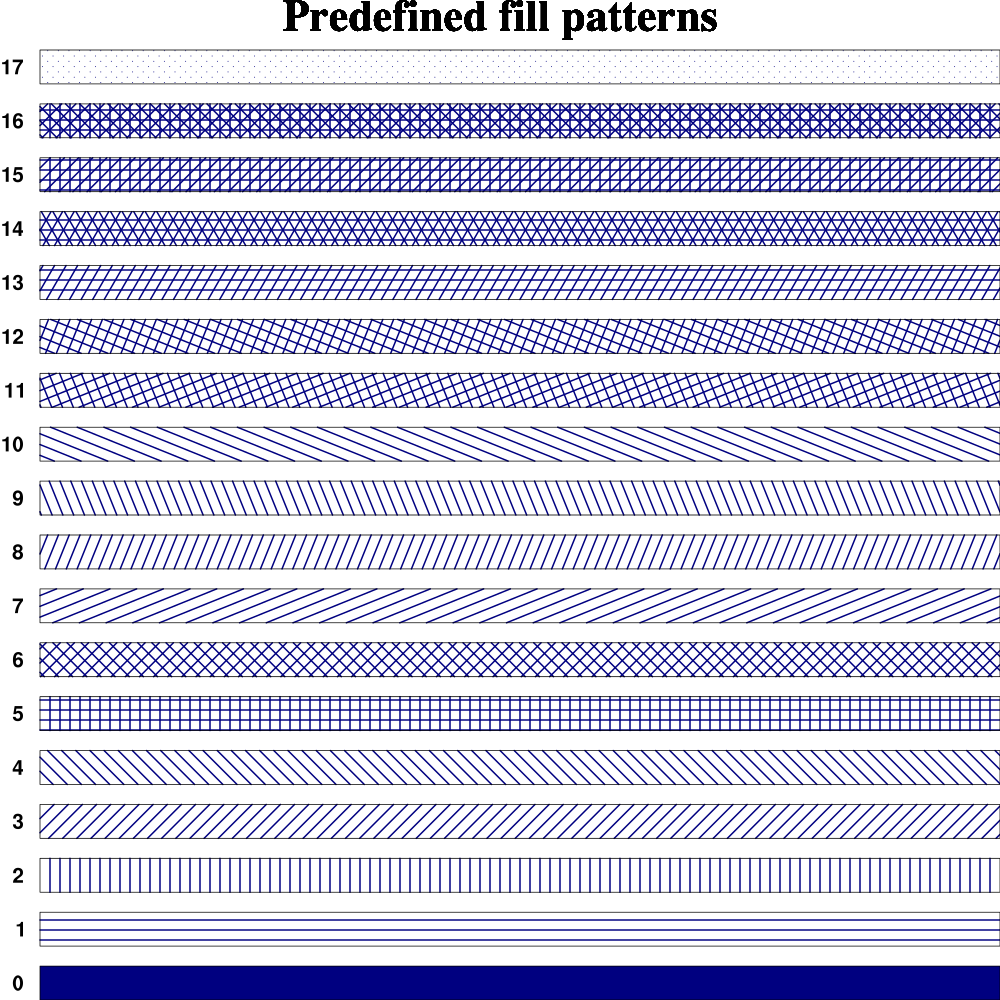
This resource sets the HLU index of the
fill pattern used to fill all
areas within the map projection that, given that mpFillOn is
True, are neither filled nor masked. If mpDefaultFillPattern
has the value
HollowFill(-1), there will be no fill of the ocean area, regardless of the setting of mpDefaultFillColor. This resource provides an alternate method of setting the value of the first element of mpFillPatterns. If both resources are set in the same call, the value of mpDefaultFillPattern takes precedence.When using the
RANGSdatabase this resource is ignored. - mpDefaultFillScaleF (MapPlot)
-
The mpDefaultFillScaleF resource controls the scaling of the
pattern used to fill all areas within the map projection that, given
that mpFillOn is True, are neither filled nor masked. It has
no effect for solid fill (
SolidFill, fill index 0). Values greater than 1.0 make the pattern spacing bigger than the default spacing, resulting in a fill that appears less dense. Values less than 1.0 have the opposite effect. Values less than or equal to 0.0 are invalid, generate a warning message, and are reset to the default value, 1.0. This resource provides an alternate method of setting the value of the first element of mpFillScales. If both resources are set in the same call, the value of mpDefaultFillScaleF takes precedence.When using the
RANGSdatabase this resource is ignored. - mpDynamicAreaGroups (MapPlot)
-
MapPlot maintains two arrays that assign
area group numbers to each
area in a MapPlot database. MapPlot
uses the area's group numbers to determine its fill attributes,
assuming mpFillOn is True and you do not explicitly specify
fill attributes for the area. The mpDynamicAreaGroups
resource allows you to access and, if desired, set the elements of the
dynamic area group array. The elements of this array have the same
order as the mpAreaNames array. By default, within the
dynamic group arrray MapPlot assigns each area a
group number such that adjoining politically distinct land areas are
guaranteed to belong to a different group. For this reason the
mpDynamicAreaGroups array is sometimes known as the
political groups array, since a map whose fill attributes are
based on these area groups shows national and perhaps state and even county boundaries
as well as physical features. Anytime mpFillBoundarySets is
set in such a way that national or U.S. state areas must be
distinguished, and the fill attributes are not set explicitly,
MapPlot uses the group numbers in the
mpDynamicAreaGroups array as indexes into the fill attribute
array resources whose associated Mono flag resource is set
False. A
more thorough description of the situations that result in
MapPlot indexing the fill attribute array resources
based on the contents of the mpDynamicAreaGroups array is
found in the discussion of area fill in the MapPlot
object description.
You may reassign the group numbers in the mpDynamicAreaGroups array in any manner you please. At minimum and by default there are 10 area groups, but by setting the resource mpAreaGroupCount you can increase the number of area groups to any number up to a maximum of 255.
- When using the
Ncarg4_0database: - See the Ncarg4_0 database table to find the dynamic area group associated with a particular area name.
- When using the
Ncarg4_1database: - There are three datasets available with this database, and the area names available differ depending on the dataset selected. See mpDataSetName for links to tables containing the dynamic area group associated with the area names contained in the available datasets.
- When using the
RANGSdatabase: - This resource is not used and is set to
NULL.
- When using the
- mpEllipticalBoundary (MapTransformation)
- When the boolean resource mpEllipticalBoundary is set True, the map projection area is limited to an ellipse inscribed within the normal rectangular perimeter of the viewport.
- mpFillAreaSpecifiers (MapPlot)
-
specify explicitly the names of areas MapPlot is to
fill. Your purpose may be to include an area that would not otherwise
be drawn (such as an interior national boundary when
mpFillBoundarySets has the value
Geophysical) or it may be simply that you want to control the area's fill attributes explicitly using the associated specified fill attribute arrays. The named areas are added to the basic set of fill areas specified using the resource mpFillBoundarySets.You may explicitly specify the fill attributes of areas named in the mpFillAreaSpecifiers array using any or all of the three associated attribute array resources, mpSpecifiedFillColors, mpSpecifiedFillPatterns, and mpSpecifiedFillScales. The elements of each of these arrays correspond one-for-one with the elements of the mpFillAreaSpecifiers array. Attributes set using these arrays override all other resources involving fill attributes, including the fill attribute Mono flags. Each of these arrays accept a pre-defined special value allowing you to specify individual elements as "unset."
If you also using area masking, note that there is an order of precedence for fill and masking. Explicitly named areas take precedence over area groupings, and small areas take precedence over enclosing larger areas. Otherwise masking takes precedence over filling.
Note that the names from different MapPlot databases and datasets are not necessarily compatible. Therefore, if mpFillAreaSpecifiers is non-NULL when you set mpDataBaseVersion and/or mpDataSetName to a different value, you are likely to encounter warning messages unless you also set mpFillAreaSpecifiers using names compatible with the new database. You can retrieve a list of compatible names by getting the value of mpAreaNames. Case is not significant for mpFillAreaSpecifiers string values.
- When using the
Ncarg4_0database: - Within the list you may include groups of areas defined by a number of pre-defined string constants. In addition, a substring matching facility allows you to specify groups of areas that share a common substring. When a fill attribute for a specified fill area is not explicitly set, MapPlot uses its normal method of setting fill attributes based on area group assignments. The group number is chosen from the mpFixedAreaGroups array or from the mpDynamicAreaGroups array depending on the setting of the resource mpSpecifiedFillPriority. You can override the general priority for an individual area by prepending an exclamation point ('!') to the area's name.
- When using the
Ncarg4_1database: - The
NullAreastring constant is also defined. There is no substring matching facility. When a fill attribute for a specified fill area is not explicitly set, MapPlot uses its normal method of setting fill attributes based on area group assignments. The group number is chosen from the mpFixedAreaGroups array if the area's type is 1 (mpGeophysical) or if its type is 2 (mpContinental) and its parent is Water. Otherwise, the group number is chosen from the mpDynamicAreaGroups array. The use of the exclamation point ('!') prefix and the mpSpecifiedFillPriority resource is not supported.Available in version 4.2.0.a034 and later.
In addition to individual area names, you can specify subdivisions of certain areas (states, provinces, and counties) using pre-defined group names appended to the area name following a colon (':') character. - When using the
RANGSdatabase: - This resource is ignored.
- When using the
- mpFillBoundarySets (MapPlot)
-
You set this resource of type
NhlTMapBoundarySets
to specify the basic boundary set used for fill areas. Given the basic
boundaries, you can then add other areas by specifying area names
outlines in the mpFillAreaSpecifiers string array
resource. You can also desiginate areas to be masked (left unfilled)
by specifying area names in the mpMaskAreaSpecifiers string array
resource.
NoBoundaries- MapPlot will draw area fill only for areas specified by name in mpFillAreaSpecifiers and not specified in mpMaskAreaSpecifiers.
Geophysical- MapPlot will draw area fill for geophysical features: land, oceans, and inland water bodies. You may specify by name other areas to be filled in the mpFillAreaSpecifiers resource.
National- MapPlot will individually fill all national boundary areas. Geophysical features are implicitly included. You may specify by name other areas to be filled in the mpFillAreaSpecifiers resource.
USStates- MapPlot will fill regions comprising the states of the
United States. When using the
Ncarg4_0database, Alaska and Hawaii are not included, although a few areas outside the U.S. proper, including the Bahamas and a few lakes extending into Canadian territory, are drawn. When using theNcarg4_1database, Alaska and Hawaii are drawn, but no non-U.S. territory is included. You may add geophysical and/or national areas by name using the mpFillAreaSpecifiers resource. GeophysicalAndUSStates- MapPlot will draw area fill for all global geophysical features as well as for the states of the United States. Other national boundaries do not appear unless you specify them by name using the mpFillAreaSpecifiers resource.
AllBoundaries- MapPlot draws area fill for all the
boundaries for the database/dataset currently in use. When using the
Ncarg4_0database this includes geophysical and national boundaries as well as all U.S. states and inland water. When using theNcarg4_1database, depending on the dataset, this may include Canadian provinces, Mexican and US States, and counties or climate divisions of US states.
When the
Ncarg4_1database is in use, specifying an area name whose mpAreaTypes is 1 or 2 (mpGeophysicalormpContinental) has the effect of suppressing type 3 or higher fill areas within its borders even if the setting of mpFillBoundarySets would otherwise imply that they be drawn . For instance, setting mpFillAreaSpecifiers to the value "Africa" would have the effect of suppressing national boundaries within the African continent.When using the
RANGSdatabase this resource is ignored. - mpFillColor (MapPlot)
- When mpMonoFillColor is set True, this resource of type NhlTColorIndex sets a uniform fill color for all MapPlot areas, except for those whose fill color is set explicitly using the mpSpecifiedFillColors array resource.
- mpFillColors (MapPlot)
-
If mpMonoFillColor is False, each element of the array
specifies the HLU color index used to fill the
MapPlot areas belonging a particular area group. The
first element of the array specifies the default color for regions
within the map projection area that contain neither a filled nor a
masked area. The second, third, and fourth elements specify colors
for the fixed (geophysical) area groups: the Ocean group, the
Land group, and the InlandWater group. For
convenience, there are named alias resources for these first four
elements of the array: mpDefaultFillColor,
mpOceanFillColor, mpLandFillColor, and
mpInlandWaterFillColor. If you set any of the alias resources
at the same time as the mpFillColors array resource is set,
the named alias resource value overrides. The remaining elements (by
default, the fifth through the tenth elements) specify colors for the
dynamic groups. If mpAreaGroupCount is increased from its
minimum (and default) value of 10, more elements become available for
additional dynamic group colors.
Default: By default the first 10 elements are assigned the following sequence of HLU color indexes: 16, 10, 8, 10, 26, 22, 11, 23, 13, 19. This choice of colors is intended to look reasonable with the "default" color map.
- mpFillDotSizeF (MapPlot)
- This resource sets a uniform dot size, in NDC units, for the stipple dot fill pattern. The default value of 0.0 causes the dots to be drawn as before, using a workstation dependent minimum dot size. A caveat is that individual dots are not clipped around the edges of fill areas; this becomes more noticeable as the dot size increases.
- mpFillDrawOrder (MapPlot)
-
This resource of type
NhlTDrawOrder determines
when MapPlot area fill is drawn relative to
other elements of the plot. There are three choices:
PreDraw- Draw area fill before the standard draw phase; the fill underlies all other MapPlot elements drawn during the predraw phase and anything drawn during the draw and postdraw phases.
Draw- Draw area fill during the standard draw; the fill overlays anything drawn during the predraw phase but underlies any other MapPlot elements drawn during the draw phase and anything drawn during the postdraw phase.
PostDraw- Draw area fill after the standard draw; the fill overlays anything drawn during the predraw and draw phases but underlies any other MapPlot elements drawn during the postdraw phase.
- mpFillOn (MapPlot)
-
This boolean resource is the master switch for drawing of
MapPlot area fill. If True, the
MapPlot enables drawing of map area fill.
Otherwise, no map fill will appear, regardless of the
setting of any other area-fill-related resources.
Default: False (True for some gsn_csm_xxxx routines)
- mpFillPatternBackground (MapPlot)
-
mpFillPatternBackground specifies the HLU index of the color
used for the background in areas filled with any HLU
fill pattern besides
SolidFill. If this resource has the valueTransparent(-1), no color will be appear behind the fill pattern. The effect will be that the pattern appears transparently on top of anything already drawn. - mpFillPattern (MapPlot)
-
When mpMonoFillPattern is set True, this resource of type
NhlTFillIndex
sets a uniform
fill pattern for
all MapPlot areas, except for those whose fill
pattern is set explicitly using the mpSpecifiedFillPatterns
array resource.
When using the
RANGSdatabase this resource is ignored. - mpFillPatterns (MapPlot)
-
If mpMonoFillPattern is False, each element of the array
specifies the HLU
fill pattern
index used to fill the MapPlot areas belonging a
particular area group. The first element of the array specifies the
default pattern for regions within the map projection area that
contain neither a filled nor a masked area. The second, third, and
fourth elements specify patterns for the fixed (geophysical) area
groups: the Ocean group, the Land group, and the
InlandWater group. For convenience, there are named alias
resources for these first four elements of the array:
mpDefaultFillPattern, mpOceanFillPattern,
mpLandFillPattern, and mpInlandWaterFillPattern. If
you set any of the alias resources at the same time as the
mpFillPatterns array resource is set, the named alias
resource value overrides. The remaining elements (by default, the
fifth through the tenth elements) specify patterns for the dynamic
groups. If mpAreaGroupCount is increased from its minimum
(and default) value of 10, more elements become available for
additional dynamic area group patterns.
When using the
RANGSdatabase this resource is ignored.Default: MapPlot assigns patterns sequentially, beginning with HLU fill pattern index 1 for the first element of mpFillPatterns.
- mpFillScaleF (MapPlot)
-
When mpMonoFillPattern is set True, this floating point
resource sets a uniform
fill pattern scale factor for all MapPlot areas,
except for those whose fill scale factor is set explicitly using the
mpSpecifiedFillScales array resource.
When using the
RANGSdatabase this resource is ignored. - mpFillScales (MapPlot)
- If mpMonoFillPattern is False, each element of the array specifies the scale factor applied to the fill pattern used to fill MapPlot areas belonging a particular area group. The first element of the array specifies the default fill pattern scale factor for regions within the map projection area that contain neither a filled nor a masked area. The second, third, and fourth elements specify scale factors for the fixed (geophysical) area groups: the Ocean group, the Land group, and the InlandWater group. For convenience, there are named alias resources for these first four elements of the array: mpDefaultFillScaleF, mpOceanFillScaleF, mpLandFillScaleF, and mpInlandWaterFillScaleF. If you set any of the alias resources at the same time as the mpFillScales array resource is set, the named alias resource value overrides. The remaining elements (by default, the fifth through the tenth elements) specify patterns for the dynamic groups. If mpAreaGroupCount is increased from its minimum (and default) value of 10, more elements become available for additional dynamic area group fill scale values.
- mpFixedAreaGroups (MapPlot)
-
MapPlot maintains two arrays that assign
area group numbers to each
area in a MapPlot database. MapPlot
uses the area's group numbers to determine its fill attributes,
assuming mpFillOn is True and you do not explicitly specify
fill attributes for the area. The mpFixedAreaGroups resource
allows read-only access for informational purposes only to the fixed
area group array, which, as its name implies, you cannot modify. The
elements of this array have the same order as the mpAreaNames
array. Within the array each area in the database is assigned to area
group 1, 2, or 3. These are respectively the Ocean group, the
Land group and the InlandWater group. For this
reason mpFixedAreaGroups is sometimes known as the
geophysical area groups array, since a map whose fill
attributes are based on these area groups shows only physical as
opposed to political features.
If fill is turned on and you set mpFillBoundarySets to the value
Geophysicaland do not explicitly specify any areas using the mpFillAreaSpecifiers resource, MapPlot will use the mpFixedAreaGroups group numbers to determine fill attributes for all areas of the map. For each of the three fill attribute types that has its Mono flag resource set False, the area's group number is used as an index into the fill attribute array resource. This yields, for mpFillColors, an HLU color index, for mpFillPatterns, an HLU fill pattern index, and for mpFillScales, a fill pattern scaling factor. A more complete description of the situations that result in MapPlot indexing the fill attribute array resources based on the contents of the mpFixedAreaGroups array is found in the discussion of area fill in the MapPlot object description.Note that you can set the fill attributes of the area groups assigned by the mpFixedAreaGroups array using a set of convenience resources that act as named aliases for the Ocean, Land, and InlandWater elements of mpFillColors, mpFillPatterns, and mpFillScales. These resources are as follows: mpOceanFillColor, mpOceanFillPattern, mpOceanFillScaleF, mpLandFillColor, mpLandFillPattern, mpLandFillScaleF, mpInlandWaterFillColor, mpInlandWaterFillPattern, and mpInlandWaterFillScaleF.
- When using the
Ncarg4_0database: - See the Ncarg4_0 database table to find the fixed area group associated with a particular area name.
- When using the
Ncarg4_1database: - There are three datasets available with this database, and the area names available differ depending on the dataset selected. See mpDataSetName for links to tables containing the fixed area group associated with the area names contained in the available datasets.
- When using the
RANGSdatabase: - This resource is not used and is set to
NULL.
- When using the
- mpGeophysicalLineColor (MapPlot)
-
This resource of type NhlTColorIndex can be set using a
named color string or an
integer value.
This resource applies to the outlines of
all continents, islands, and inland water bodies. However, when mpDataBaseVersion is set to
Ncarg4_0(LowRes) and the outlines of one or more U.S. states are drawn, the portion of North America whose outline is contiguous with the U.S. border is rendered using mpUSStateLineColor. - mpGeophysicalLineDashPattern (MapPlot)
-
This resource sets the index specifying the dash pattern
used to render geophysical boundary lines. This resource applies to
the outlines of all continents, islands and inland water bodies.
However, when mpDataBaseVersion is set to
Ncarg4_0(LowRes) and the outlines of one or more U.S. states are drawn, the portion of North America whose outline is contiguous with the U.S. border is rendered using mpUSStateLineDashPattern. - mpGeophysicalLineDashSegLenF (MapPlot)
-
This resource specifies the length of each segment of the dash
patterns used to draw geophysical boundary outlines. It is the length
in NDC before the dash pattern
repeats itself. This resource automatically scales with changes in
the size of the viewport of the MapPlot object.
This resource applies to
the outlines of all continents, islands and inland water bodies.
However, when mpDataBaseVersion is set to
Ncarg4_0(LowRes) and the outlines of one or more U.S. states are drawn, the portion of North America whose outline is contiguous with the U.S. border is rendered using mpUSStateLineDashSegLenF.MapPlot sets the default value of mpNationalLineDashSegLenF dynamically based on the ratio of the actual plot viewport width to a reference viewport width of 0.6 and a reference dash segment length of 0.15.
- mpGeophysicalLineThicknessF (MapPlot)
-
Sets the thickness of the lines used to draw geophysical boundary
outlines. The value acts as a multiplier of a (device-dependent) unit
thickness.
This resource applies to
the outlines of all continents, islands and inland water bodies.
However, when mpDataBaseVersion is set to
Ncarg4_0(LowRes) and the outlines of one or more U.S. states are drawn, the portion of North America whose outline is contiguous with the U.S. border is rendered using mpUSStateLineDashSegLenF. - mpGreatCircleLinesOn (MapTransformation)
-
This resource selects between two methods for defining the
transformation of lines or edges between defined points of the data
space graphics primitive functions, NhlDataPolygon and NhlDataPolyline. If
mpGreatCircleLinesOn is False, the space between the
defined points is treated as if the latitude/longitude coordinate
system were cartesian. This method of performing the transformation
results in all straight lines between the defined points when
mpProjection is set to
CylindricalEquidistant. Another characteristic of this method is that, for any projection, a line between two points at the same latitude is coincident with the line of latitude itself.If mpGreatCircleLinesOn is set True, lines between defined points follow a great circle route, the shortest distance on the surface of the globe between the two points. In this case, lines appear curved on a cylindrical equidistant projection, except for the special cases of lines between points of equal longitude or of lines drawn near the equator. For any projection, lines between points of equal latitude diverge farther and farther from the line of latitude as the distance from the equator increases.
- mpGridAndLimbDrawOrder (MapPlot)
-
This resource of type
NhlTDrawOrder determines
when MapPlot draws the grid lines representing
latitude and longitude relative to other elements of the plot. When a
limb line representing the edge of the visible surface of the
projection is required, MapPlot always renders it at
the same time as the grid lines. There are three choices:
PreDraw- Draw grid lines before the standard draw phase; the grid lines overlay MapPlot fill drawn during the predraw phase but underlie other predraw phase MapPlot elements and anything drawn during the draw and postdraw phases.
Draw- Draw grid lines during the standard draw; the grid lines overlay anything drawn during the predraw phase and MapPlot fill drawn during the draw phase but underlie other draw phase MapPlot elements and anything drawn during the postdraw phase.
PostDraw- Draw grid lines after the standard draw; the grid lines overlay anything drawn during the predraw and draw phases and MapPlot fill drawn during the postdraw phase but underlie other postdraw phase MapPlot elements.
- mpGridAndLimbOn (MapPlot)
- This boolean resource determines whether the MapPlot object draws grid lines representing latitude and longitude as well as (when appropriate) a limb line around the edge of the visible surface of the map projection.
- mpGridLatSpacingF (MapPlot)
- This resource specifies the spacing, in degrees, between MapPlot grid lines representing latitude. Use this resource if you want to set the latitude spacing independently of the longitude spacing. Note that setting mpGridSpacingF at the same time or subsequently overrides the value of this resource.
- mpGridLineColor (MapPlot)
- This resource sets the HLU index of a color used to draw the grid representing latitudes and longitudes.
- mpGridLineDashPattern (MapPlot)
- This resource sets the HLU index of a dash pattern used to draw the grid representing latitudes and longitudes.
- mpGridLineDashSegLenF (MapPlot)
- This resource specifies the length of each segment of the dash patterns used to draw the grid representing latitudes and longitudes. It is the length in NDC before the dash pattern repeats itself. This resource automatically scales with changes in the size of the viewport of the MapPlot object. MapPlot sets the default value of mpGridLineDashSegLenF dynamically based on the ratio of the actual plot viewport width to a reference viewport width of 0.6 and a reference dash segment length of 0.15.
- mpGridLineThicknessF (MapPlot)
- This resource determines the thickness of the lines used to draw the grid representing latitudes and longitudes. The value acts as a multiplier of a (device-dependent) unit thickness.
- mpGridLonSpacingF (MapPlot)
- This resource specifies the spacing, in degrees, between MapPlot grid lines representing longitude. Use this resource if you want to set the longitude spacing independently of the latitude spacing. Note that setting mpGridSpacingF at the same time or subsequently overrides the value of this resource.
- mpGridMaskMode (MapPlot)
-
This resource of type
NhlTMapGridMaskMode specifies
how the MapPlot object should mask the grid representing
latitudes and longitudes. There are seven choices:
MaskNone- MapPlot does not mask the grid. Grid lines appear over the entire visible map projection area.
MaskOcean- MapPlot masks the grid over areas of the map occupied by any part of the global ocean.
MaskNotOcean- MapPlot masks the grid over areas of the map that are not part of the global ocean, including bodies of water within the interior of continents.
MaskLand- MapPlot masks the grid over areas of the map that represent land. Bodies of water within the interior of continents remain unmasked.
MaskNotLand- MapPlot masks the grid over all areas of the map that do not represent land, including bodies of water within the interior of continents.
MaskFillArea- MapPlot masks the grid over filled or masked areas in the map. The grid is drawn only over 'background' areas within the map projection, that is, those areas of the MapPlot that would be filled (assuming fill is enabled) using the color specified by mpDefaultFillColor.
MaskMaskArea- MapPlot masks the grid only over areas named in the mpMaskAreaSpecifiers array.
When using the
RANGSdatabase this resource is ignored. - mpGridMaxLatF (MapPlot)
- This resource specifies the maximum absolute value of the latitude at which a latitude grid line may appear. For instance, if you set mpGridMaxLatF to 70.0, no latitude lines will appear between 70 degrees and 90 degrees or between -70 degrees and -90 degrees. If the latitude spacing were set to 20.0, then, in this case, the highest and lowest latitude lines would be at 60 degrees and -60 degrees.
- mpGridPolarLonSpacingF (MapPlot)
- This resource has an effect only when the map projection is such that the North and South poles project to single points. In this case, it controls the way longitude lines are continued in the area between the pole and the latitude line nearest the pole. Basically it allows you to set an alternate spacing for longitude lines near the poles, generally for the purpose of avoiding overcrowding. For instance, if mpGridPolarLonSpacingF is set to its default value of 90.0 and the longitudinal spacing is set to 15.0, then only the longitude lines that are multiples of 90.0 continue to the poles. Note that if the longitudinal spacing were set to 20.0, lines would continue only at multiples of 180.0, since there would be no longitude lines to continue at 90.0 and 270.0.
- mpGridSpacingF (MapPlot)
- This resource specifies the spacing, in degrees, between MapPlot grid lines representing latitude and longitude. Use this resource if you want the spacing to be equal in latitude and longitude. Setting this resource overrides any values set for the resources mpGridLatSpacingF and mpGridLonSpacingF and causes them both to be set to the value given mpGridSpacingF.
- mpInlandWaterFillColor (MapPlot)
-
This resource sets the HLU index of the color used to fill areas
representing bodies of water except for the oceans.
mpInlandWaterFillColor is constrained to values greater than
-1 (
Transparent). This resource provides an alternate method of setting the value of the fourth element of mpFillColors. If both resources are set in the same call, the value of mpInlandWaterFillColor takes precedence. - mpInlandWaterFillPattern (MapPlot)
-
This resource sets the HLU index of the
fill pattern used to fill areas
representing bodies of water except for the oceans. If
mpInlandWaterFillPattern has the value
HollowFill(-1), there will be no fill of the inland water area, regardless of the setting of mpInlandWaterFillColor. This resource provides an alternate method of setting the value of the fourth element of mpFillPatterns. If both resources are set in the same call, the value of mpInlandWaterFillPattern takes precedence.When using the
RANGSdatabase this resource is ignored. - mpInlandWaterFillScaleF (MapPlot)
-
The mpInlandWaterFillScaleF resource controls the scaling of
the pattern used to fill areas representing bodies of water except for
the oceans. It has no effect for solid fill (
SolidFill, fill pattern index 0). Values greater than 1.0 make the pattern spacing bigger than the default spacing, resulting in a fill that appears less dense. Values less than 1.0 have the opposite effect. Values less than or equal to 0.0 are invalid, generate a warning message, and are reset to the default value, 1.0. This resource provides an alternate method of setting the value of the fourth element of mpFillScales. If both resources are set in the same call, the value of mpInlandWaterFillScaleF takes precedence.When using the
RANGSdatabase this resource is ignored. - mpLabelDrawOrder (MapPlot)
-
This resource of type
NhlTDrawOrder determines
when MapPlot labels are drawn relative to
other elements of the plot. There are three choices:
PreDraw- Draw labels before the standard draw phase; the labels overlay all other MapPlot elements drawn during the predraw phase but underlie anything drawn during the draw and postdraw phases.
Draw- Draw labels during the standard draw; the labels overlay anything drawn during the predraw phase and any other MapPlot elements drawn during the draw phase but underlie anything drawn during the postdraw phase.
PostDraw- Draw labels after the standard draw; the labels overlay anything drawn during the predraw and draw phases and all other MapPlot elements drawn during the postdraw phase.
- mpLabelFontColor (MapPlot)
- This resource specifies the hlu color index used to draw the characters used for MapPlot labels.
- mpLabelFontHeightF (MapPlot)
- This resource controls the height in NDC of characters used in the MapPlot labels. The MapPlot text height scales with changes to the viewport width, unless you explicitly set mpLabelFontHeightF during the same call.
- mpLabelsOn (MapPlot)
- This boolean resource determines whether the MapPlot object draws labels identifying the equator ("EQ"), Greenwich Meridian ("GM"), International Dateline ("ID"), North Pole ("NP"), and South Pole ("SP").
- mpLambertMeridianF (MapTransformation)
-
When mpProjection is set to the value
LambertConformal, this resource specifies the central meridian (line of longitude in degrees) of the projection. This resource has nearly the same meaning that mpCenterLonF has for the other projections. - mpLambertParallel1F (MapTransformation)
-
When mpProjection is set to the value
LambertConformal, this resource specifies one of the two standard parallels (lines of latitude in degrees) used to define the conic projection. A simpler conic projection is defined when mpLambertParallel1F and mpLambertParallel2F are equal. Normally, mpLambertParallel1F and mpLambertParallel2F should not be more than 90.0 degrees apart. - mpLambertParallel2F (MapTransformation)
-
When mpProjection is set to the value
LambertConformal, this resource specifies one of the two standard parallels (lines of latitude in degrees) used to define the conic projection. A simpler conic projection is defined when mpLambertParallel1F and mpLambertParallel2F are equal. Normally, mpLambertParallel1F and mpLambertParallel2F should not be more than 90.0 degrees apart. - mpLandFillColor (MapPlot)
-
This resource sets the HLU index of the color used to fill areas of
land not given a special group color. mpLandFillColor is
constrained to values greater than -1 (
Transparent). This resource provides an alternate method of setting the value of the third element of mpFillColors. If both resources are set in the same call, the value of mpLandFillColor takes precedence. - mpLandFillPattern (MapPlot)
-
This resource sets the HLU index of the
fill pattern used to fill areas of
land not given a special group color. If mpLandFillPattern
has the value
HollowFill(-1), there will be no fill of the land area, regardless of the setting of mpInlandWaterFillColor. This resource provides an alternate method of setting the value of the third element of mpFillPatterns. If both resources are set in the same call, the value of mpLandFillPattern takes precedence.When using the
RANGSdatabase this resource is ignored. - mpLandFillScaleF (MapPlot)
-
The mpLandFillScaleF resource controls the scaling of the
pattern used to fill areas of land not given a special group color. It
has no effect for solid fill (
SolidFill, fill pattern index 0). Values greater than 1.0 make the pattern spacing bigger than the default spacing, resulting in a fill that appears less dense. Values less than 1.0 have the opposite effect. Values less than or equal to 0.0 are invalid, generate a warning message, and are reset to the default value, 1.0. This resource provides an alternate method of setting the value of the third element of mpFillScales. If both resources are set in the same call, the value of mpLandFillScaleF takes precedence.When using the
RANGSdatabase this resource is ignored. - mpLeftAngleF (MapTransformation)
-
When mpLimitMode has the value
Angles, this resource specifies the positive angle in degrees left from the center to the edge of the projection, or, if using a satellite projection, the displacement angle left from the satellite line of sight to the projection center. Note that direction of the line over which the angle is measured remains parallel to the top of the viewport, regardless of the rotation angle applied to the projection. mpLeftAngleF has a maximum allowable value that varies depending on the projection. - mpLeftCornerLatF (MapTransformation)
-
When mpLimitMode has the value
Corners, this resource specifies the latitude, in degrees, of the left corner point. - mpLeftCornerLonF (MapTransformation)
-
When mpLimitMode has the value
Corners, this resource specifies the longitude, in degrees, of the left corner point. - mpLeftMapPosF (MapTransformation)
- This read-only resource contains the coordinate of the left edge of the projected area in NDC space.
- mpLeftNDCF (MapTransformation)
-
When mpLimitMode has the value
NDC, this resource specifies the left edge of the limiting rectangle in Normalized Device Coordinates. If mpLeftNDCF is set to a value greater than mpRightNDCF, a warning is issued and the values are exchanged. Since the relationship between the map projection area and NDC coordinates changes whenever the map limits are changed, as well as when the viewport area is moved or resized, MapTransformation resets the value of mpLeftNDCF to the NDC value of the left edge of the projected area at the end of any update to the transformation. - mpLeftNPCF (MapTransformation)
-
When mpLimitMode has the value
NPC, this resource specifies the left edge of the limiting rectangle in Normalized Projection Coordinates. mpLeftNPCF is constrained to values in the range 0.0 through 1.0. If mpLeftNPCF is set to a value greater than mpRightNPCF, a warning is issued and the values are exchanged. The value of mpLeftNPCF is updated whenever the map limits are set using any of the map limit modes. - mpLeftPointLatF (MapTransformation)
-
When mpLimitMode has the value
Points, this resource specifies the latitude, in degrees, of a point along the left edge of the limiting rectangle. - mpLeftPointLonF (MapTransformation)
-
When mpLimitMode has the value
Points, this resource specifies the longitude, in degrees, of a point along the left edge of the limiting rectangle. - mpLeftWindowF (MapTransformation)
-
When mpLimitMode has the value
Window, this resource specifies the value, in window coordinates, of the left edge of the projection. - mpLimbLineColor (MapPlot)
- This resource sets the HLU index of the color used for the limb line drawn at the edge of visibility in certain map projections.
- mpLimbLineDashPattern (MapPlot)
- This resource sets the HLU index of a dash pattern used for the limb line drawn at the edge of visibility in certain map projections.
- mpLimbLineDashSegLenF (MapPlot)
- This resource specifies the length of each segment of the dash patterns used for the limb line drawn at the edge of visibility in certain map projections. It is the length in NDC before the dash pattern repeats itself. This resource automatically scales with changes in the size of the viewport of the MapPlot object. MapPlot sets the default value of mpLimbLineDashSegLenF dynamically based on the ratio of the actual plot viewport width to a reference viewport width of 0.6 and a reference dash segment length of 0.15.
- mpLimbLineThicknessF (MapPlot)
- This resource determines the thickness of the limb line drawn at the edge of visibility in certain map projections. The value acts as a multiplier of a (device-dependent) unit thickness.
- mpLimitMode (MapTransformation)
-
This resource of type NhlTMapLimitMode specifies how MapTransformation determines the extent of the projected globe that is mapped into the viewport area. It has eight possible settings:
MaximalArea- The maximum viewable area of the globe allowed by the projection is mapped into the viewport area.
LatLon- MapTransformation maps into the viewport the maximum viewable portion of the area given the projection, the projection center, and bounded by latitudes mpMinLatF and mpMaxLatF and longitudes mpMinLonF and mpMaxLonF. If you set boundaries such that the resulting area has zero extent, MapTransformation issues a warning and resets mpLimitMode to the value NhlMAXIMALAREA. If you set mpMinLatF to a value greater than mpMaxLatF or mpMinLonF to a value greater than mpMaxLatF, MapTransformation issues a warning and exchanges the values.
Angles- For most projections, the area mapped into the viewport is based
on the positive angular distance from the center of the projection, in
each of the four directions determined by the resources
mpRightAngleF, mpLeftAngleF,mpBottomAngleF,
and mpTopAngleF. For the satellite projection, the angles
represent angular deviation from the line of sight from the satellite
to the projection center. Angular limits are not supported if
mpProjection has the value NhlLAMBERTCONFORMAL or NhlROTATEDMERCATOR. Note that
left, right, bottom, and top are oriented with respect to the viewplane;
therefore, if mpCenterRotF has a non-zero value,
the angles represent varying combinations of latitudinal and longitudinal
components.
Depending on the projection, the maximum allowable value for each of the angle resources varies, as follows:
Orthographic- mpLeftAngleF and mpRightAngleF: 90.0
mpBottomAngleFand mpTopAngleF: 90.0 Stereographic- mpLeftAngleF and mpRightAngleF: 180.0
mpBottomAngleFand mpTopAngleF: 180.0 LambertEqualArea- mpLeftAngleF and mpRightAngleF: 180.0
mpBottomAngleFand mpTopAngleF: 180.0 Gnomonic- mpLeftAngleF and mpRightAngleF: 85.0
mpBottomAngleFand mpTopAngleF: 85.0 AzimuthalEquidistant- mpLeftAngleF and mpRightAngleF: 180.0
mpBottomAngleFand mpTopAngleF: 180.0 Satellite- mpLeftAngleF and mpRightAngleF: 90.0
mpBottomAngleFand mpTopAngleF: 90.0 Mollweide- mpLeftAngleF and mpRightAngleF: 180.0
mpBottomAngleFand mpTopAngleF: 180.0 Mercator- mpLeftAngleF and mpRightAngleF: 180.0
mpBottomAngleFand mpTopAngleF: 85.0 CylindricalEquidistant- mpLeftAngleF and mpRightAngleF: 180.0
mpBottomAngleFand mpTopAngleF: 90.0 LambertConformal- not supported
Robinson- mpLeftAngleF and mpRightAngleF: 180.0
mpBottomAngleFand mpTopAngleF: 90.0 CylindricalEqualArea- mpLeftAngleF and mpRightAngleF: 180.0
mpBottomAngleFand mpTopAngleF: 90.0 RotatedMercator- not supported
NPCNPClimits the area based on "Normalized Projection Coordinates," which map the maximal area of the projection into a rectangle bounded by 0.0 and 1.0 horizontally and vertically. Use the resources mpLeftNPCF, mpRightNPCF, mpBottomNPCF, and mpTopNPCF to set normalized projection coordinate limits. If you set NPC boundaries such that the resulting area has zero extent, MapTransformation issues a warning and resets mpLimitMode to the value NhlMAXIMALAREA. If you set mpLeftNPCF to a value greater than mpRightNPCF or mpBottomNPCF to a value greater than mpTopNPCF, MapTransformation issues a warning and exchanges the values. MapTransformation keeps the NPC resources updated to their current value no matter which method is used to set the map limits.NDCNDClimits the area based on the current location of the projected map in Normalized Device Coordinates. Use the resources mpLeftNDCF, mpRightNDCF, mpBottomNDCF, and mpTopNDCF to set normalized device coordinate limits. If you set NDC boundaries such that the resulting area has zero extent, MapTransformation issues a warning and resets mpLimitMode to the value NhlMAXIMALAREA. If you set mpLeftNDCF to a value greater than mpRightNDCF or mpBottomNDCF to a value greater than mpTopNDCF, MapTransformation issues a warning and exchanges the values. Note that setting these resources usually causes the mapping between the projection space and NDC space to change. Changes to the location of the size or shape of the viewport into which the map is projected also modify the mapping into NDC space. Therefore, at the completion of each SetValues call, MapTransformation internally sets the value of each mp...NDCF resource to the new location of the original projected coordinate: that is, to one of the boundaries of the projected area.Corners- MapTransformation maps into the viewport a rectangular
area with one corner at the point mpLeftCornerLatF and
mpLeftCornerLonF, and the opposite corner at the point
mpRightCornerLatF and mpRightCornerLonF. The value
of mpLeftCornerLonF should be less than
mpRightCornerLonF. If either point is outside the maximal
area given the projection and projection center, a warning is returned
and the limit mode defaults to
MaximalArea. Points- MapTransformation maps into the viewport an area
defined by a viewspace rectangle containing the four points defined by
mpLeftPointLatF, mpLeftPointLonF,
mpRightPointLatF, mpRightPointLonF,
mpBottomPointLatF, mpBottomPointLonF,
mpTopPointLatF, and mpTopPointLonF. If any point is
outside the maximal area given the projection and projection center, a
warning is returned and the limit mode defaults to
MaximalAreamode. Window- MapTransformation maps into the viewport an area
bounded by the window coordinates specified by the resources
mpLeftWindowF, mpRightWindowF,
mpBottomWindowF, and mpTopWindowF. The window
coordinates are in an intermediate rectangular coordinate system into
which the map coordinates are mapped prior to the mapping into NDC
coordinates. Its extents vary depending on the value of
mpProjection. If you set mpLeftWindowF to
a value greater than mpRightWindowF, or
mpBottomWindowF to a value greater than mpTopWindowF,
MapTransformation issues a warning and exchanges the
values. MapTransformation keeps the
Windowresources updated to their current value no matter which method is used to set the map limits.
- mpMaskAreaSpecifiers (MapPlot)
-
Specify the names of areas MapPlot is to mask. These
areas are subtracted from the fill area set specified using the
resource mpFillBoundarySets and
mpFillAreaSpecifiers. There is an order of precedence for
fill and masking. Explicitly named areas take precedence over area
groupings, and small areas take precedence over enclosing larger
areas. Otherwise masking takes precedence over filling.
Note that the names from different MapPlot databases are not necessarily compatible. Therefore, if mpMaskAreaSpecifiers is non-NULL when you set mpDataBaseVersion and/or mpDataSetName to a different value, you are likely to encounter warning messages unless you also set mpMaskAreaSpecifiers using names compatible with the new database. You can retrieve a list of compatible names by getting the value of mpAreaNames. Case is not significant for mpMaskAreaSpecifiers string values.
- When using the
Ncarg4_0database: - In addition to the individual area names, you may include certain pre-defined groups of areas using a number of pre-defined string constants. Moreover, there is a substring matching facility that allows you to specify groups of areas sharing a common substring.
- When using the
Ncarg4_1database: - The
NullAreastring constant is defined. Due to the hierarchical nature of this database many area groupings occur as named entities in their own right. For instance, you can mask filling of the small islands of the Pacific Ocean by including the string "Pacific Islands" as an element of mpMaskAreaSpecifiers. There is no substring matching facility.Available in version 4.2.0.a034 and later.
In addition to individual area names, you can specify subdivisions of certain areas (states, provinces, and counties) using pre-defined group names appended to the area name following a colon (':') character. - When using the
RANGSdatabase: - This resource is ignored.
- When using the
- mpMaskOutlineSpecifiers (MapPlot)
-
Available in version 4.2.0.a034 and later.
Specify the names of outlines MapPlot is to mask, if the boolean resource mpOutlineMaskingOn is set to True. These outlines are subtracted from the outline set specified using the resource mpOutlineBoundarySets and mpOutlineSpecifiers. Note that commonly the outline of an area shares its border with a number of other areas. Masking the outline of an area causes all these common borders not to be drawn. There is an order of precedence for outline drawing masking. Explicitly named outlines take precedence over outline groupings, and small outlines take precedence over enclosing larger outlines. Otherwise masking takes precedence over filling.
Note that the names from different MapPlot databases and/or datasets are not necessarily compatible. Therefore, if mpMaskOutlineSpecifiers is non-NULL when you set mpDataBaseVersion and/or mpDataSetName to a different value, you are likely to encounter warning messages unless you also set mpMaskOutlineSpecifiers using names compatible with the new database. You can retrieve a list of compatible names for the current database/dataset by getting the value of mpAreaNames. Case is not significant for mpMaskOutlineSpecifiers string values.
- When using the
Ncarg4_0database: - In addition to the individual area names, you may include certain pre-defined groups of areas using a number of pre-defined string constants. Moreover, there is a substring matching facility that allows you to specify groups of areas sharing a common substring.
- When using the
Ncarg4_1database: - The
NullAreastring constant is defined. Due to the hierarchical nature of this database, many area groupings occur as named entities in their own right. For instance, you can mask the outlines of the small islands of the Pacific Ocean by including the string "Pacific Islands" as an element of mpMaskOutlineSpecifiers. There is no substring matching facility.In addition to individual area names, you can specify subdivisions of certain areas (states, provinces, and counties) using pre-defined group names appended to the area name following a colon (':') character.
There are some subtleties involved in outline masking when using the
Ncarg4_1database that do not occur with area masking. Areas with higher types override lower typed areas. For instance, if you want to mask interior water bodies to simplify the appearance of a map, you might specify "Water" as an element of mpMaskOutlineSpecifiers. However, this would cause all ocean coast lines to disappear because "Ocean" is a member of the "Water" hierarchy. You can overcome this problem by adding "Ocean" to the mpOutlineSpecifier array resource. Since "Ocean" is a type 2 entity it overrides the masking of "Water", one of the two type 1 entities. Also If you add national, state, or county outlines to a map in which the inland water bodies have been masked, you will find that some water bodies still appear. That is because they form part of the the boundary between entities that have been specified. - When using the
RANGSdatabase: - This resource is ignored.
- When using the
- mpMaxLatF (MapTransformation)
-
When mpLimitMode has the value
LatLon, this resource specifies the maximum latitude bounding the area to be mapped to the viewport. It should not be greater than 90.0. - mpMaxLonF (MapTransformation)
-
When mpLimitMode has the value
LatLon, this resource specifies the maximum longitude bounding the area to be mapped to the viewport. It may be set to any value in the range -540.0 to 540.0 such that mpMaxLonF minus mpMinLonF is greater than 0.0 and less than or equal to 360.0. - mpMinLatF (MapTransformation)
-
When mpLimitMode has the value
LatLon, this resource specifies the minimum latitude bounding the area to be mapped to the viewport. It should not be less than -90.0. - mpMinLonF (MapTransformation)
-
When mpLimitMode has the value
LatLon, this resource specifies the minimum longitude bounding the area to be mapped to the viewport. It may be set to any value in the range -540.0 to 540.0 such that mpMaxLonF minus mpMinLonF is greater than 0.0 and less than or equal to 360.0. - mpMonoFillColor (MapPlot)
- When set True, all MapPlot fill areas (other than those whose color is set explicitly using the mpSpecifiedFillColors array resource) are set to a single color, as specified by the value of the scalar resource mpFillColor. When False, the elements of the array resource mpFillColors control the fill color indexes for MapPlot areas based on the area group numbers assigned to each area.
- mpMonoFillPattern (MapPlot)
-
When set True, all MapPlot fill areas (other than
those whose pattern is set explicitly using the
mpSpecifiedFillPatterns array resource) are set to a
single pattern, as specified by
the value of the scalar resource mpFillPattern. When False,
the elements of the array resource mpFillPatterns control the
fill pattern indexes for MapPlot areas based on the
area group numbers assigned to each area.
When using the
RANGSdatabase this resource is ignored. - mpMonoFillScale (MapPlot)
-
When set True, all MapPlot fill areas (other than
those whose fill scale is set explicitly using the
mpSpecifiedFillScales array resource) use a single fill
pattern scale factor, as specified by the value of the scalar resource
mpFillScaleF. When False, the elements of the array resource
mpFillScales control the fill scale values for
MapPlot areas based on the area group numbers assigned
to each area.
When using the
RANGSdatabase this resource is ignored. - mpNationalLineColor (MapPlot)
-
This resource sets the HLU index of a color used to render interior
national boundary outlines. Note that this
resource applies only to lines used to draw interior national
boundaries. Lines separating continents, oceans, and inland water bodies are not
affected, except that if mpDataBaseVersion is set to
Ncarg4_0(LowRes) and US States are drawn, the US national border is rendered using mpUSStateLineColorWhen using the
RANGSdatabase this resource is ignored. - mpNationalLineDashPattern (MapPlot)
-
This resource sets the HLU index of a
dash pattern used to render
interior national boundary outlines. Note that this resource applies
only to lines used to draw interior national boundaries. Lines separating
continents, oceans, and inland water bodies are not
affected, except that if mpDataBaseVersion is set to
Ncarg4_0(LowRes) and US States are drawn, the US national border is rendered using mpUSStateDashPattern.When using the
RANGSdatabase this resource is ignored.Default:
SolidLine - mpNationalLineDashSegLenF (MapPlot)
-
This resource specifies the length of each segment of the dash
patterns used to draw national boundary outlines. It is the length in
NDC before the
dash pattern repeats itself. This
resource automatically scales with changes in the size of the viewport
of the MapPlot object. Note that this resource
applies only to lines used to draw interior national boundaries. Lines separating
continents, oceans, and inland water bodies are not
affected, except that if mpDataBaseVersion is set to
Ncarg4_0(LowRes) and US States are drawn, the US national border is rendered using mpUSStateDashSegLenF.MapPlot sets the default value of mpNationalLineDashSegLenF dynamically based on the ratio of the actual plot viewport width to a reference viewport width of 0.6 and a reference dash segment length of 0.15.
When using the
RANGSdatabase this resource is ignored. - mpNationalLineThicknessF (MapPlot)
-
Sets the thickness of the lines used to draw national boundary
outlines. The value acts as a multiplier of a (device-dependent) unit
thickness. Note that this resource applies only to lines used to draw
interior national boundaries. Note that this resource
applies only to lines used to draw interior national boundaries. Lines separating
continents, oceans, and inland water bodies are not
affected, except that if mpDataBaseVersion is set to
Ncarg4_0(LowRes) and US States are drawn, the US national border is rendered using mpUSStateLineThicknessF.When using the
RANGSdatabase this resource is ignored. - mpOceanFillColor (MapPlot)
-
This resource sets the HLU index of the color used to fill areas
representing the oceans. mpOceanFillColor is constrained to
values greater than -1 (
Transparent). This resource provides an alternate method of setting the value of the second element of mpFillColors. If both resources are set in the same call, the value of mpOceanFillColor takes precedence. - mpOceanFillPattern (MapPlot)
-
This resource sets the HLU index of the
fill pattern used to fill areas
representing the oceans. If mpOceanFillPattern has the value
HollowFill(-1), there will be no fill of the ocean area, regardless of the setting of mpOceanFillColor. This resource provides an alternate method of setting the value of the second element of mpFillPatterns. If both resources are set in the same call, the value of mpOceanFillPattern takes precedence.When using the
RANGSdatabase this resource is ignored. - mpOceanFillScaleF (MapPlot)
-
The mpOceanFillScaleF resource controls the scaling of the
pattern used to fill areas representing the oceans. It has no effect
for solid fill (
SolidFill, fill pattern index 0). Values greater than 1.0 make the pattern spacing bigger than the default spacing, resulting in a fill that appears less dense. Values less than 1.0 have the opposite effect. Values less than or equal to 0.0 are invalid, generate a warning message, and are reset to the default value, 1.0. This resource provides an alternate method of setting the value of the second element of mpFillScales. If both resources are set in the same call, the value of mpOceanFillScaleF takes precedence.When using the
RANGSdatabase this resource is ignored. - mpOutlineBoundarySets (MapPlot)
-
You set this resource of type
NhlTMapBoundarySets
to specify the basic boundary set used to render area outlines. Given
the basic boundaries, you can then add other outline areas by
specifying area names in the mpOutlineSpecifiers string
array resource. There are six choices:
NoBoundaries- MapPlot will draw area outlines only for areas specified by name in mpOutlineSpecifiers.
Geophysical- MapPlot will draw area outlines for geophysical features: continents, oceans, islands, and inland water areas. Specific national boundary lines may be added by name in mpOutlineSpecifiers.
National- MapPlot will draw area outlines delineating all
national boundary areas as contained in the MapPlot
database being used. All the geophysical features specified by
Geophysicalare implicitly included. You may add U.S. State area outlines by name using the mpOutlineSpecifiers resource. USStates- MapPlot will draw area outlines delineating the
states of the United States. When using the
Ncarg4_0database, Alaska and Hawaii are not included, although a few areas outside the U.S. proper, including the Bahamas and a few lakes extending into Canadian territory, are drawn. When using theNcarg4_1database, Alaska and Hawaii are drawn, but no non-U.S. territory is included. You may add geophysical and/or national areas by name using the mpOutlineSpecifiers resource. GeophysicalAndUSStates- MapPlot will draw area outlines of all global geophysical features as well as the states of the U.S. Other national boundaries do not appear unless you specify them by name using the mpOutlineSpecifiers resource.
AllBoundaries- MapPlot draws outlines for all the
boundaries for the database/dataset currently in use. When using the
Ncarg4_0database this includes geophysical and national boundaries as well as all U.S. states and inland water. When using theNcarg4_1database, depending on the dataset, this may include Canadian provinces, Mexican and US States, and counties or climate divisions of US states.
When using the Ncarg4_1 database, specifying an area name whose mpAreaTypes is 1 or 2 (
mpGeophysicalormpContinental) has the effect of suppressing type 3 or higher boundaries within its borders even if the setting of mpFillBoundarySets would otherwise imply that they be drawn . For instance, setting mpOutlineSpecifiers to the value "Africa" would have the effect of suppressing national boundaries within the African continent.When using the
RANGSdatabase this resource is ignored. - mpOutlineDrawOrder (MapPlot)
-
This resource of type
NhlTDrawOrder determines
when MapPlot area outlines are drawn relative to
other elements of the plot. There are three choices:
PreDraw- Draw the area outlines before the standard draw phase; the lines will overlay MapPlot fill and grid or limb lines also drawn during the predraw phase but will underlie MapPlot labels and perimeter lines drawn during the predraw phase and anything drawn during the draw and postdraw phases.
Draw- Draw the area outlines during the standard draw; the lines will overlay any elements drawn during the predraw phase, as well as MapPlot fill and grid or limb lines drawn during the standard draw phase, but will underlie MapPlot labels and perimeter lines drawn during the draw phase and anything drawn during the postdraw phase.
PostDraw- Draw the lines after the standard draw; the lines will overlay all MapPlot elements except for labels and perimeter lines drawn during the postdraw phase.
- mpOutlineMaskingOn (MapPlot)
-
Available in version 4.2.0.a034 and later.
This boolean resource is the master switch for enabling the outline masking facility. If True, MapPlot enables outline masking, causing the boundaries of areas named in the mpMaskOutlineSpecifiers array to remain undrawn. If False, no masking is performed, regardless of the contents of mpMaskOutlineSpecifiers. For convenience, setting mpMaskOutlineSpecifiers causes mpOutlineMaskingOn to be set True, if it is not explicitly set otherwise in the same call.
When using the
RANGSdatabase this resource is ignored. - mpOutlineOn (MapPlot)
-
This boolean resource is the master switch for drawing of
MapPlot area outlines. If True, the
MapPlot enables drawing of map area
outlines. Otherwise, these outlines will not appear, regardless of the
setting of any other area-outline-related resources. However, note
that this resource does not apply to MapPlot grid or
limb lines or to the perimeter line.
Default: True (False for some gsn_csm_xxxx routines)
- mpOutlineSpecifiers (MapPlot)
-
You use the array resource mpOutlineSpecifiers to
specify particular area outlines MapPlot is to
draw by name. These areas are added to the basic outline area set
specified using the resource
mpOutlineBoundarySets. Note that the names from
different MapPlot databases and datasets are not
necessarily compatible. Therefore, if
mpOutlineSpecifiers is non-NULL when you set
mpDataBaseVersion and/or
mpDataSetName to a different value, you are likely to
encounter warning messages unless you also set
mpOutlineSpecifiers using names compatible with the
new database. You can retrieve a list of compatible names by getting
the value of mpAreaNames. Case is not significant for
mpOutlineSpecifiers string values.
- When using the
Ncarg4_0database: - In addition to the individual area names, you may include certain pre-defined groups of areas using a number of pre-defined string constants. Moreover, there is a substring matching facility that allows you to specify groups of areas sharing a common substring.
- When using the
Ncarg4_1database: - The
NullAreastring constant is defined. Due to the hierarchical nature of this database, many area groupings occur as named entities in their own right. For instance, you can draw the small islands of the Pacific Ocean by including the string "Pacific Islands" as an element of mpOutlineSpecifiers. There is no substring matching facility.Available in version 4.2.0.a034 and later.
In addition to individual area names, you can specify subdivisions of certain areas (states, provinces, and counties) using pre-defined group names appended to the area name following a colon (':') character. - When using the
RANGSdatabase: - This resource is ignored.
- When using the
- mpPerimDrawOrder (MapPlot)
-
This resource of type
NhlTDrawOrder determines
when the perimeter line around the edge of the map projection is drawn
relative to other elements of the plot. There are three choices:
PreDraw- Draw the perimeter before the standard draw phase; the perimeter overlays all other MapPlot elements drawn during the predraw phase except MapPlot labels but underlies anything drawn during the draw and postdraw phases.
Draw- Draw the perimeter during the standard draw; the perimeter overlays anything drawn during the predraw phase and any other MapPlot elements (except MapPlot labels) drawn during the draw phase but underlies anything drawn during the postdraw phase.
PostDraw- Draw the perimeter after the standard draw; the perimeter overlays anything drawn during the predraw and draw phases and all other MapPlot elements (except MapPlot labels) drawn during the postdraw phase.
- mpPerimLineColor (MapPlot)
- This resource sets the HLU index of the color used to render the perimeter line around the edge of the map projection.
- mpPerimLineDashPattern (MapPlot)
- This resource sets the HLU index of a dash pattern used to render the perimeter line around the edge of the map projection.
- mpPerimLineDashSegLenF (MapPlot)
- This resource specifies the length of each segment of the dash patterns used to draw the perimeter line around the edge of the map projection. It is the length in NDC before the dash pattern repeats itself. This resource automatically scales with changes in the size of the viewport of the MapPlot object. MapPlot sets the default value of mpPerimLineDashSegLenF dynamically based on the ratio of the actual plot viewport width to a reference viewport width of 0.6 and a reference dash segment length of 0.15.
- mpPerimLineThicknessF (MapPlot)
- This resource determines the thickness of the perimeter line around the edge of the map projection. The value acts as a multiplier of a (device-dependent) unit thickness.
- mpPerimOn (MapPlot)
- This boolean resource determines whether the MapPlot object draws a perimeter line around the edge of the map projection. Depending on the setting of the MapTransformation resource mpEllipticalBoundary, this perimeter may have a rectangular or elliptical shape.
- mpPolyMode (MapTransformation)
-
Available in version 6.2.0 and later.
This resource takes three possible values: "StandardPoly", "FastPoly", and "AutoPoly". It allows you to set which method to use when adding polygons to a map plot.
The default is "AutoPoly", which means that NCL decides which type of polygon to draw based on the great circle distance of each component line segment and on the polygon's GraphicStyle attributes. If the great circle distance of any component line segment is greater than 10 degress or if any fill pattern other than solid is in effect, then the "StandardPoly" method is used, which was always in effect in NCL versions 6.1.2 and earlier. Otherwise, the "FastPoly" method is used, which was introduced in NCL version 6.2.0.
- mpProjection (MapTransformation)
-
This resource of type NhlTProjection defines the
projection used for the map transformation. There are several choices:
Orthographic- Transform using an aziumthal orthographic projection.
Stereographic- Transform using an azimuthal stereographic projection.
LambertEqualArea- Transform using the azimuthal Lambert Equal-Area projection.
Gnomonic- Transform using the azimuthal gnomonic projection.
AzimuthalEquidistant- Transform using an azimuthal equidistant projection.
Satellite- Transform using an azimuthal satellite projection.
PseudoMollweide- Transform using a PseudoMollweide projection. Prior to version 5.1.0 this projection was specified simply as "Mollweide". However, a more correct implementation of the "Mollweide" projection has now been given that name, while the "PseudoMolleweide" projection is still available for backwards compatibility.
Mercator- Transform using the cylindrical Mercator projection.
CylindricalEquidistant- Transform using a cylindrical equidistant projection.
LambertConformal- Transform using the conical Lambert Conformal projection.
Robinson- Transform using a Robinson projection.
CylindricalEqualArea- Transform using a CylindricalEqualArea projection.
RotatedMercator- Transform using a RotatedMercator projection.
Aitoff(Available in version 5.1.0 and later.)- Transform using a Aitoff projection.
Hammer(Available in version 5.1.0 and later.)- Transform using a Hammer projection.
Mollweide(Available in version 5.1.0 and later.)- Transform using a cylindrical Mollweide projection. Note that as of version 5.1.0 the original Mollweide-type projection has been replaced with an improved version that more correctly implements the projection. The original Mollweide-like projection is still available using the name "PseudoMollweide".
WinkelTripel(Available in version 5.1.0 and later.)- Transform using a WinkelTripel projection.
- mpProvincialLineColor (MapPlot)
-
Available in version 6.1.0 and later.
This resource of type NhlTColorIndex can be set using a named color string or an integer value.
When mpDataBaseVersion is set to
Ncarg4_1(MediumRes) it specifies the color used to render interior provincial or state boundary outlines for a selected number of countries. It has no effect on boundary lines that are coincident with geographical boundaries or on inland water bodies that border or are enclosed within a state or province.When mpDataBaseVersion is set to
Ncarg4_0(LowRes) it specifies the color used to render state boundary outlines for the Conterminous United States and a few nearby islands. In this case, it also controls the color of the geophysical boundaries of the United States including inland water bodies, such as the Great Lakes, that border the country as a whole.This resource is an another name for the mpUSStatesLineColor resource. The name has been updated to reflect its more universal applicability. When using the
RANGSdatabase this resource is ignored. - mpProvincialLineDashPattern (MapPlot)
-
Available in version 6.1.0 and later.
This resource sets the index specifying the dash pattern used to render state or provincial boundary lines.
When mpDataBaseVersion is set to
Ncarg4_1(MediumRes) it specifies the dash pattern used to render interior provincial or state boundary outlines for a selected number of countries. It has no effect on boundary lines that are coincident with geographical boundaries or on inland water bodies that border or are enclosed within a state or province.When mpDataBaseVersion is set to
Ncarg4_0(LowRes) it specifies the dash pattern used to render state boundary outlines for the Conterminous United States and a few nearby islands. In this case, it also controls the color of the geophysical boundaries of the United States including inland water bodies, such as the Great Lakes, that border the country as a whole.This resource is another name for the mpUSStatesLineDashPattern resource, updated to reflect its more universal applicability. When using the
RANGSdatabase this resource is ignored. p> Default:SolidLine - mpProvincialLineDashSegLenF (MapPlot)
-
Available in version 6.1.0 and later.
This resource specifies the length of each segment of the dash patterns used to render state or provincial boundary outlines. It is the length in NDC before the dash pattern repeats itself. This resource automatically scales with changes in the size of the viewport of the MapPlot object.
When mpDataBaseVersion is set to
Ncarg4_1(MediumRes) it specifies the segment length used to render interior provincial or state boundary outlines for a selected number of countries. It has no effect on boundary lines that are coincident with geographical boundaries or on inland water bodies that border or are enclosed within a state or province.When mpDataBaseVersion is set to
Ncarg4_0(LowRes) it specifies the segment length used to render state boundary outlines for the Conterminous United States and a few nearby islands. In this case, it also controls the color of the geophysical boundaries of the United States including inland water bodies, such as the Great Lakes, that border the country as a whole.This resource is another name for the mpUSStatesLineDashSegLenF resource, updated to reflect its more universal applicability. When using the
RANGSdatabase this resource is ignored.MapPlot sets the default value of mpProvincialLineDashSegLenF dynamically based on the ratio of the actual plot viewport width to a reference viewport width of 0.6 and a reference dash segment length of 0.15.
- mpProvincialLineThicknessF (MapPlot)
-
Available in version 6.1.0 and later.
This resource Sets the thickness of the lines used to render state or provincal boundary outlines. The value acts as a multiplier of a (device-dependent) unit thickness.
When mpDataBaseVersion is set to
Ncarg4_1(MediumRes) it specifies the thickness used to render interior provincial or state boundary outlines for a selected number of countries. It has no effect on boundary lines that are coincident with geographical boundaries or on inland water bodies that border or are enclosed within a state or province.When mpDataBaseVersion is set to
Ncarg4_0(LowRes) it specifies the thickness used to render state boundary outlines for the Conterminous United States and a few nearby islands. In this case, it also controls the color of the geophysical boundaries of the United States including inland water bodies, such as the Great Lakes, that border the country as a whole.This resource is another name for the mpUSStatesLineThicknessF resource, updated to reflect its more universal applicability. When using the
RANGSdatabase this resource is ignored. - mpRelativeCenterLat (MapTransformation)
-
When mpLimitMode has the value
LatLonand mpRelativeCenterLat is set True, the resource mpCenterLatF becomes an offset in degrees from the latitude halfway between mpMinLatF and mpMaxLatF. That is, if mpCenterLatF is 0.0, the half point latitude will be the center of the projection. - mpRelativeCenterLon (MapTransformation)
-
When mpLimitMode has the value
LatLonand mpRelativeCenterLon is set True, the resource mpCenterLonF becomes an offset in degrees from the longitude halfway between mpMinLonF and mpMaxLonF. That is, if mpCenterLonF is 0.0, the half point longitude will be the center of the projection. - mpRightAngleF (MapTransformation)
-
When mpLimitMode has the value
Angles, this resource specifies the positive angle in degrees right from the center to the edge of the projection, or, if using a satellite projection, the displacement angle right from the satellite line of sight to the projection center. Note that direction of the line over which the angle is measured remains parallel to the top of the viewport, regardless of the rotation angle applied to the projection. mpRightAngleF has a maximum allowable value that varies depending on the projection. - mpRightCornerLatF (MapTransformation)
-
When mpLimitMode has the value
Corners, this resource specifies the latitude, in degrees, of the right corner point. - mpRightCornerLonF (MapTransformation)
-
When mpLimitMode has the value
Corners, this resource specifies the longitude, in degrees, of the right corner point. - mpRightMapPosF (MapTransformation)
- This read-only resource contains the coordinate of the right edge of the projected area in NDC space.
- mpRightNDCF (MapTransformation)
-
When mpLimitMode has the value
NDC, this resource specifies the right edge of the limiting rectangle in Normalized Device Coordinates. If mpRightNDCF is set to a value less than mpLeftNDCF, a warning is issued and the values are exchanged. Since the relationship between the map projection area and NDC coordinates changes whenever the map limits are changed, as well as when the viewport area is moved or resized, MapTransformation resets the value of mpRightNDCF to the NDC value of the right edge of the projected area at the end of any update to the transformation. - mpRightNPCF (MapTransformation)
-
When mpLimitMode has the value
NPC, this resource specifies the right edge of the limiting rectangle in Normalized Projection Coordinates. mpRightNPCF is constrained to values in the range 0.0 through 1.0. If mpRightNPCF is set to a value less than mpLeftNPCF, a warning is issued and the values are exchanged. The value of mpRightNPCF is updated whenever the map limits are set using any of the map limit modes. - mpRightPointLatF (MapTransformation)
-
When mpLimitMode has the value
Points, this resource specifies the latitude, in degrees, of a point along the right edge of the limiting rectangle. - mpRightPointLonF (MapTransformation)
-
When mpLimitMode has the value
Points, this resource specifies the longitude, in degrees, of a point along the right edge of the limiting rectangle. - mpRightWindowF (MapTransformation)
-
When mpLimitMode has the value
Window, this resource specifies the value, in window coordinates, of the right edge of the projection. - mpSatelliteAngle1F (MapTransformation)
-
When mpProjection is set to
Satelliteand mpSatelliteDistF has a value greater than 1.0, this resource specifies the angle in degrees between a line to the center of the earth and the line of sight (to which the projection plane is perpendicular). - mpSatelliteAngle2F (MapTransformation)
-
This resource only has an effect when mpProjection is set to
Satellite, mpSatelliteDistF has a value greater than 1.0, and mpSatelliteAngle1F has a non-zero value. Imagine a compass (the geometrical instrument) with its joint at the position of the satellite, its first leg extending to the center of the earth, and the second pointing in the direction of the line of sight. The second leg is longer than the first, so that it meets a plane through the center of the earth normal to the first leg. The angle in degrees between the two legs is SatelliteAngle1F. When SatelliteAngle2F has the value 0.0, a line drawn from the first leg of the compass to the second will appear horizontal and directed toward the right. Increasing values of SatelliteAngle2F correspond to counterclockwise rotations of the compass, (and hence, the line of sight) from this base position. - mpSatelliteDistF (MapTransformation)
-
When mpProjection is set to
Satellite, this resource specifies the distance in multiples of the earth's radius of the satellite at the view origin. If the value is 1.0 or less, the satellite projection is replaced by its limiting case: an orthographic projection. - mpShapeMode (MapPlot)
-
This resource of type
NhlTMapShapeMode allows you to
control whether the map projection preserves its intrinsic shape
(aspect ratio), and in addition, if the aspect ratio is to be
preserved, whether the MapPlot bounding box should be
resized to fit the map projection extent exactly. It has three possible
settings:
FreeAspect- Do not preserve the map projection aspect ratio. The projected area is "stretched" along either the horizontal or the vertical View axis such that it fills the specified View area.
FixedAspectFitBB- Preserve the map projection aspect ratio. The projected area is made as large as possible and centered within the View area. Then MapPlot resizes its View area such that its perimeter matches the bounding box of the projected area.
FixedAspectNoFitBB- Preserve the map projection aspect ratio. The projected area is made as large as possible and centered within the View area. MapPlot does not resize its View area.
- mpSpecifiedFillColors (MapPlot)
-
You may use this array resource to set explicitly the fill color of any
MapPlot area specified by name in the
mpFillAreaSpecifiers array resource, overriding the usual
method of determining an area's fill color based on its assigned area
group numbers. The elements of the mpSpecifiedFillColors
array correspond one-for-one to the elements of the
mpFillAreaSpecifiers array.
Depending on the setting of the boolean resource mpSpecifiedFillDirectIndexing, you control the level of indirection in the way MapPlot interprets the values in mpSpecifiedFillColors. If mpSpecifiedFillDirectIndexing is True, MapPlot treats the values of mpSpecifiedFillColors as HLU color indexes directly determining the fill color of the specified areas. Otherwise, MapPlot considers each value as a MapPlot group number that temporarily overrides the group numbers normally assigned to the area. In this case, MapPlot determines the HLU fill color by using this temporary group number as an index into the mpFillColors array.
You may cause any element of the mpFillAreaSpecifiers array to retain its normal color by setting the corresponding element of mpSpecifiedFillColors to the special value
NullColor(-1). If mpSpecifiedFillColors has fewer elements than mpFillAreaSpecifiers MapPlot sets all the extra elements of mpFillAreaSpecifiers using its normal scheme. If mpSpecifiedFillColors has more elements, MapPlot ignores them. If any of the elements of mpSpecifiedFillColors are invalid, MapPlot issues a warning and assigns the area a color using the normal scheme.When using the
RANGSdatabase this resource is ignored. - mpSpecifiedFillDirectIndexing (MapPlot)
-
This boolean resource determines whether the values contained in the
specified fill attribute array resources
(mpSpecifiedFillColors, mpSpecifiedFillPatterns, and
mpSpecifiedFillScales)
directly specify the attribute value, or whether they specify an area
group number used as an index into the regular fill attribute array
resources (mpFillColors, mpFillPatterns, and
mpFillScales). When mpSpecifiedFillDirectIndexing is
set True, the values of mpSpecifiedFillColors elements
represent HLU color indexes, the values of
mpSpecifiedFillPatterns elements represent HLU pattern
indexes, and the values of mpSpecifiedFillPatterns elements
represent fill pattern scaling factors. Otherwise, the elements of
these arrays are converted into integers that represent area group
numbers.
When using the
RANGSdatabase this resource is ignored. - mpSpecifiedFillPatterns (MapPlot)
-
You may use this array resource to set explicitly the
fill pattern of any
MapPlot area specified by name in the
mpFillAreaSpecifiers array resource, overriding the usual
method of determining an area's fill pattern based on its assigned
area group numbers. The elements of the
mpSpecifiedFillPatterns array correspond one-for-one to the
elements of the mpFillAreaSpecifiers array.
Depending on the setting of the boolean resource mpSpecifiedFillDirectIndexing, you control the level of indirection in the way MapPlot interprets the values in mpSpecifiedFillPatterns. If mpSpecifiedFillDirectIndexing is True, MapPlot treats the values of mpSpecifiedFillPatterns as HLU pattern indexes directly determining the fill pattern of the specified areas. Otherwise, MapPlot considers each value as a MapPlot group number that temporarily overrides the group numbers normally assigned to the area. In this case, MapPlot determines the HLU fill pattern by using this temporary group number as an index into the mpFillPatterns array.
You may cause any element of the mpFillAreaSpecifiers array to retain its normal pattern by setting the corresponding element of mpSpecifiedFillPatterns to the special value
NullFill(-1). If mpSpecifiedFillPatterns has fewer elements than mpFillAreaSpecifiers, MapPlot sets all the extra elements of mpFillAreaSpecifiers using its normal scheme. If mpSpecifiedFillPatterns has more elements, MapPlot ignores them. If any of the elements of mpSpecifiedFillPatterns are invalid, MapPlot issues a warning and assigns the area a pattern using the normal scheme.When using the
RANGSdatabase this resource is ignored. - mpSpecifiedFillPriority (MapPlot)
-
- When using the
Ncarg4_0database: -
Based on the setting of this resource of type
NhlTSpecifiedFillPriority,
MapPlot decides how to choose a group number for
indexing into the regular fill attribute arrays for areas specified in
the mpFillAreaSpecifiers resource. The group number is only
used to determine fill attributes that have not been specified
explicitly using the specified fill attribute arrays. The choices are
as follows:
GeophysicalPriority- Use group numbers from the mpFixedAreaGroups array as an index into the fill attribute arrays.
PoliticalPriority- Use group numbers from the mpDynamicAreaGroups array as an index into the fill attribute arrays.
- When using the
Ncarg4_1database: - The mpSpecifiedFillPriority resource is not supported.
- When using the
RANGSdatabase: - This resource is ignored.
- When using the
- mpSpecifiedFillScales (MapPlot)
-
You may use this array resource to explicitly set the fill pattern
scale factor of any MapPlot area specified by name in
the mpFillAreaSpecifiers array resource, overriding the usual
method of determining an area's fill scale based on its assigned area
group numbers. The elements of the mpSpecifiedFillScales
array correspond one-for-one to the elements of the
mpFillAreaSpecifiers array.
Depending on the setting of the boolean resource mpSpecifiedFillDirectIndexing, you control the level of indirection in the way MapPlot interprets the values in mpSpecifiedFillScales. If mpSpecifiedFillDirectIndexing is True, MapPlot treats the values of mpSpecifiedFillScales as floating point values directly determining the fill scale of the specified areas. Otherwise, MapPlot converts each number into an integer and treats it as a MapPlot group number that temporarily overrides the group numbers normally assigned to the area. In this case, MapPlot determines the fill scale value by using this temporary group number as an index into the mpFillScales array.
You may cause any element of the FillAreaSpecifiers array to retain its normal fill scale value by setting the corresponding element of mpSpecifiedFillScales to the special value 0.0. If mpSpecifiedFillScales has fewer elements than mpFillAreaSpecifiers, MapPlot sets all the extra elements of mpFillAreaSpecifiers using its normal scheme. If mpSpecifiedFillScales has more elements, MapPlot ignores them. If any of the elements of mpSpecifiedFillScales are invalid, MapPlot issues a warning and assigns the area a scale using the normal scheme.
Note that a kludge is required if mpSpecifiedFillDirectIndexing is set False, so that you are indexing into the mpFillScales array using group numbers, and you want to specify that a fill scale be determined by indexing into element 0 of mpFillScales. You would need to set the element of mpSpecifiedFillScales using a number larger than 0.0 but less than 1.0. If you set the value to 0.0, it would be interpreted as the special value causing MapPlot to use its "normal" method of determining the fill scale for the area.
When using the
RANGSdatabase this resource is ignored. - mpTopAngleF (MapTransformation)
-
When mpLimitMode has the value
Angles, this resource specifies the positive angle in degrees up from the center to the edge of the projection, or, if using a satellite projection, the displacement angle up from the satellite line of sight to the projection center. Note that direction of the line over which the angle is measured remains parallel to the left edge of the viewport, regardless of the rotation angle applied to the projection. mpTopAngleF has a maximum allowable value that varies depending on the projection. - mpTopMapPosF (MapTransformation)
- This read-only resource contains the coordinate of the top edge of the projected area in NDC space.
- mpTopNDCF (MapTransformation)
-
When mpLimitMode has the value
NDC, this resource specifies the top edge of the limiting rectangle in Normalized Device Coordinates. If mpTopNDCF is set to a value less than mpBottomNDCF, a warning is issued and the values are exchanged. Since the relationship between the map projection area and NDC coordinates changes whenever the map limits are changed, as well as when the viewport area is moved or resized, MapTransformation resets the value of mpTopNDCF to the NDC value of the top edge of the projected area at the end of any update to the transformation. - mpTopNPCF (MapTransformation)
-
When mpLimitMode has the value
NPC, this resource specifies the top edge of the limiting rectangle in Normalized Projection Coordinates. mpTopNPCF is constrained to values in the range 0.0 through 1.0. If mpTopNPCF is set to a value less than mpBottomNPCF, a warning is issued and the values are exchanged. The value of mpTopNPCF is updated whenever the map limits are set using any of the map limit modes. - mpTopPointLatF (MapTransformation)
-
When mpLimitMode has the value
Points, this resource specifies the latitude, in degrees, of a point along the top edge of the limiting rectangle. - mpTopPointLonF (MapTransformation)
-
When mpLimitMode has the value
Points, this resource specifies the longitude, in degrees, of a point along the top edge of the limiting rectangle. - mpTopWindowF (MapTransformation)
-
When mpLimitMode has the value
Window, this resource specifies the value, in window coordinates, of the top edge of the projection. - mpUSStateLineColor (MapPlot)
-
This resource of type NhlTColorIndex can be set using a named color string or an integer value.
When mpDataBaseVersion is set to
Ncarg4_1(MediumRes) it specifies the color used to render interior provincial or state boundary outlines for a selected number of countries. It has no effect on boundary lines that are coincident with geographical boundaries or on inland water bodies that border or are enclosed within a state or province.When mpDataBaseVersion is set to
Ncarg4_0(LowRes) it specifies the color used to render state boundary outlines for the Conterminous United States and a few nearby islands. In this case, it also controls the color of the geophysical boundaries of the United States including inland water bodies, such as the Great Lakes, that border the country as a whole.This resource is an another name for the mpProvincialLineColor resource, which has been added to reflect its more universal applicability. When using the
RANGSdatabase this resource is ignored.When using the
RANGSdatabase this resource is ignored. - mpUSStateLineDashPattern (MapPlot)
-
This resource sets the index specifying the dash pattern
used to render state or provincial boundary lines.
When mpDataBaseVersion is set to
Ncarg4_1(MediumRes) it specifies the dash pattern used to render interior provincial or state boundary outlines for a selected number of countries. It has no effect on boundary lines that are coincident with geographical boundaries or on inland water bodies that border or are enclosed within a state or province.When mpDataBaseVersion is set to
Ncarg4_0(LowRes) it specifies the dash pattern used to render state boundary outlines for the Conterminous United States and a few nearby islands. In this case, it also controls the color of the geophysical boundaries of the United States including inland water bodies, such as the Great Lakes, that border the country as a whole.This resource is another name for the mpProvincialLineDashPattern resource, which has been added to reflect its more universal applicability. When using the
RANGSdatabase this resource is ignored. - mpUSStateLineDashSegLenF (MapPlot)
-
This resource specifies the length of each segment of the dash
patterns used to render state or provincial boundary outlines. It is the length in
NDC before the
dash pattern repeats itself. This
resource automatically scales with changes in the size of the viewport
of the MapPlot object.
When mpDataBaseVersion is set to
Ncarg4_1(MediumRes) it specifies the segment length used to render interior provincial or state boundary outlines for a selected number of countries. It has no effect on boundary lines that are coincident with geographical boundaries or on inland water bodies that border or are enclosed within a state or province.When mpDataBaseVersion is set to
Ncarg4_0(LowRes) it specifies the segment length used to render state boundary outlines for the Conterminous United States and a few nearby islands. In this case, it also controls the color of the geophysical boundaries of the United States including inland water bodies, such as the Great Lakes, that border the country as a whole.This resource is another name for the mpProvincialLineDashSegLenF resource, which has been added to reflect its more universal applicability. When using the
RANGSdatabase this resource is ignored.MapPlot sets the default value of mpProvincialLineDashSegLenF dynamically based on the ratio of the actual plot viewport width to a reference viewport width of 0.6 and a reference dash segment length of 0.15.
- mpUSStateLineThicknessF (MapPlot)
-
This resource Sets the thickness of the lines used to render state or provincal boundary
outlines. The value acts as a multiplier of a (device-dependent) unit
thickness.
When mpDataBaseVersion is set to
Ncarg4_1(MediumRes) it specifies the thickness used to render interior provincial or state boundary outlines for a selected number of countries. It has no effect on boundary lines that are coincident with geographical boundaries or on inland water bodies that border or are enclosed within a state or province.When mpDataBaseVersion is set to
Ncarg4_0(LowRes) it specifies the thickness used to render state boundary outlines for the Conterminous United States and a few nearby islands. In this case, it also controls the color of the geophysical boundaries of the United States including inland water bodies, such as the Great Lakes, that border the country as a whole.This resource is another name for the mpProvincialLineThicknessF resource, updated to reflect its more universal applicability. When using the
RANGSdatabase this resource is ignored.Default: 1.0